
Vattenfall: Nature-inclusive engineering with innovative Nature enhancements at gigawatt scale
At a Glance
- Partners: BASF, Allianz (co-owners); De Rijke Noordzee / The Rich North Sea; Royal Netherlands Institute for Sea Research (NIOZ), Deltares, Waardenburg Ecology, Seaward, Wageningen Marine Research (nature-inclusive design and monitoring); Siemens Gamesa (recyclable blades); North Sea farmers (seaweed co-location pilot)
- Investment type: Company-funded by Vattenfall; enabled by a government-backed grid connection and competitive tender process, but developed without direct government subsidy.
- Key business benefit: Demonstrates that nature-inclusive design is commercially viable at gigawatt scale without subsidy, while SeaLab builds a reusable R&D platform that secure comprehensive knowledge for future projects
- Key outcomes: 139 turbines, 1.5 GW installed capacity, ~1.5 TWh generated annually, powering more than 1.5 million households with fossil-free electricity since 2024; nature-inclusive design and construction of turbine foundations and blades; novel habitat creation on scour protection and within turbine foundations, as well as piloting co-use with seaweed cultivation.
The Opportunity
Offshore wind is a core growth sector in the ocean economy and must scale up rapidly to support decarbonization and energy security.[1] Yet this expansion within heavily used marine environments demands that deployment contribute to ecosystem recovery, rather than just minimize harm. Newer projects are already moving beyond impact avoidance towards net-positive ecological and social outcomes alongside energy production.[2]
The Approach
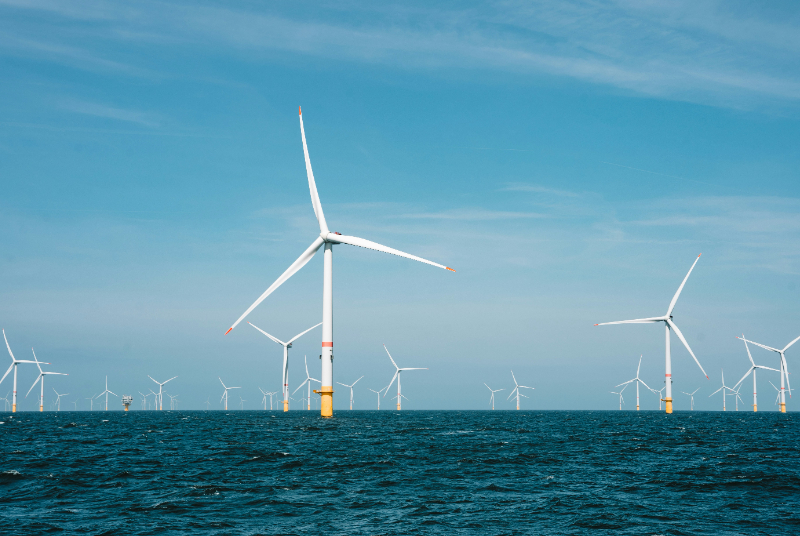
Hollandse Kust Zuid (HKZ), located 18-36 km off the Dutch coast in the North Sea, is one of the largest examples in practice. Jointly owned by Vattenfall, BASF and Allianz, it has 139 turbines and 1.5 gigawatts (GW) of installed capacity, producing approximately 1.5 terawatt-hours (TWh) of electricity annually – enough for more than 1.5 million households. Funded by Vattenfall and operational since 2024, HKZ is the first offshore wind farm in Europe developed without direct government subsidies.[3] The project contributes to industrial decarbonization while supplying fossil-free electricity to businesses and households.[4]
The project was enabled by a stable regulatory environment, Dutch government-backed grid connections, visibility on future market volumes and a tender process that reduced risk for private investors while allowing power to be sold into wholesale markets. HKZ also functions as a testbed for innovation and ecosystem enhancement. The research and development platform, SeaLab, convenes research institutes, universities and other stakeholders with the purpose of disseminating scientific knowledge on ecological initiatives and circular supply chain design. Working with De Rijke Noordzee, Vattenfall added elliptical openings to turbine foundations to allow water exchange and create shelter for marine species, installed artificial rock reefs on scour protection to increase habitat complexity and deployed a double bubble curtain to reduce construction noise while monitoring the impacts on marine mammals.[5] This work embeds nature-inclusive design in the wind farm’s infrastructure and operations.[6]
Further pilots include using thermal cameras and AI to trigger temporary shutdowns during peak bird migration and working with North Sea farmers to test a floating seaweed farm between turbines to explore co-location of renewable energy with sustainable food production. Vattenfall is also trialling recyclable blades, developed by Siemens Gamesa, to reduce the lifecycle impact of offshore infrastructure.[7] Results are still being assessed, with monitoring informing adaptive management.
Early results from independent monitoring by The Rich North Sea indicate initial colonisation of turbine foundations by fish and invertebrates in the novel turbine structure.[8] Monitoring of this site will inform continued adaptive management. HKZ shows that site-level regenerative measures are achievable at scale.
Value Created
The benefit to Vattenfall is demonstrating that nature-inclusive design is commercially viable at gigawatt scale, which will only increase in relevance as future tenders increasingly weigh environmental performance alongside price. SeaLab also serves as long-term investment in enabling innovation: the AI bird-monitoring system, recyclable blade trial, and pilots for seaweed farms can be revisited and adapted for future projects.
The benefit to society is the generation of fossil-free energy equivalent to more than 1.5 million households.
The benefit to nature, summarised in the contributions to the Global Biodiversity Framework:
- Targets 2 and 11 (restoration and ecosystem services): water replenishment holes and artificial rock reefs increase habitat complexity and shelter within an actively used industrial marine site, the first time a turbine's own structure has been used this way
- Target 4 (species recovery / reducing human-wildlife conflict): noise mitigation during construction via a double bubble curtain and AI-triggered shutdowns during bird migration reduce direct disturbance to harbour porpoises and migratory seabirds.
- Target 8 (climate change mitigation): roughly 1.5 TWh of annual fossil-free electricity contributes to decarbonization at a scale relevant to Dutch energy targets.
Why It Matters / Key Takeaways
HKZ provides evidence that nature-inclusive design is commercially viable at gigawatt scale when enabling policy and partnerships are in place. However, site measures alone will not deliver system-wide regeneration without supportive governance and cross-sector coordination. Scaling-up from project to system requires marine spatial planning, cross-sector coordination and policy signals that reward net-positive contribution, not just impact mitigation.
Relevant global targets:
- 2 (restoration), 4 (species), 8 (climate mitigation), 11 (ecosystem services)
References
- European Environment Agency. (2024). Harnessing offshore wind while preserving the seas, Briefing No. 14/2024. https://doi.org/10.2800/3621684
- Soininen, N., Huhta, K. & Vesa, S. (2025). Offshore Wind Power through the Lenses of EU Climate, Energy and Environmental Law—Between Climate Aspirations, Market Competition and Environmental Impact. Ocean Development & International Law, vol. 56, no. 4, pp. 505-525. https://doi.org/10.1080/00908320.2025.2587359
- Vattenfall. (n.d.). Hollandse Kust Zuid. https://powerplants.vattenfall.com/hollandse-kust-zuid/
- Ibid
- Krogh, M. (2023). Vattenfall goes the extra mile for dolphins in Denmark. Vattenfall. https://group.vattenfall.com/pressand-media/newsroom/2023/vattenfall-goes-the-extra-mile-for-dolphins-in-denmark/
- Vattenfall. (2021). Annual and Sustainability Report 2021, pp. 50-51. https://group.vattenfall.com/investors/financialcalendar/annual-and-sustainability-report-2021/
- Vattenfall. (2022). Vattenfall offshore wind farm will use recyclable wind turbine blades. https://group.vattenfall.com/pressand-media/newsroom/2022/vattenfall-offshore-wind-farm-will-use-recyclable-wind-turbine-blades/
- The Rich North Sea (n.d.). Vattenfall. https://www.therichnorthsea.com/project/vattenfall/