In May 2024, the Dominican Republic's Ministry of Industry, Commerce and MSMEs (MICM) and the Global Plastic Action Partnership (GPAP) began exploring opportunities to advance trade and the circular economy for plastics.
These discussions underscored the need for a stronger evidence base to identify practical pathways for sustainable development.
As a result, the country prioritized a baseline analysis to inform future waste management policies and investment decisions—laying the foundation for long-term, evidence-based action.
In September 2024, the Dominican Republic took a major step in the fight against plastic pollution, becoming the first Caribbean nation to partner with GPAP.
Through this collaboration, the country established a National Plastic Action Partnership (NPAP) to reduce plastic pollution while driving sustainable and inclusive growth.
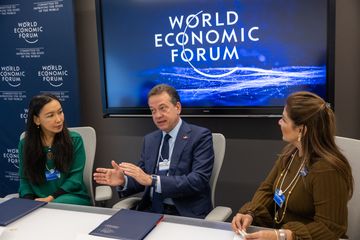
The Dominican Republic is taking a decisive step toward the future, embracing an economic model that prioritizes sustainability and innovation. With the support of the World Economic Forum and the clear, resolute vision of President Luis Abinader, we are laying the groundwork for a nation that protects its environment while fostering balanced, harmonious economic growth.
Minister of Industry, Commerce, and MSMEs of the Dominican Republic
Building on more than a decade of national efforts to tackle plastic waste, including the landmark 2020 Solid Waste Law (Law 225-20), the NPAP Dominican Republic brings together government, business, academia, and civil society to accelerate the transition toward a circular plastics economy.
By fostering innovation, sharing knowledge, and aligning national priorities with global goals, the NPAP serves as a platform to advance sustainable waste management, promote circular solutions, and shape policies that will guide the country toward a cleaner, more resilient future.
The NPAP Dominican Republic has a strong and inclusive governance structure.
In December 2024, the Ministry of Industry, Commerce, and MSMEs (MICM) convened the Steering Committee, comprising 24 institutions from government, business, academia, and civil society.
The committee provides strategic guidance on data, targets, and circularity objectives, ensuring that the national roadmap remains grounded in the Dominican context and shaped by diverse stakeholder perspectives.
National District City Council
Public-Private Trust for Integrated Solid Waste Management, DO Sostenible
September | Dominican Republic joins GPAP
Signing the Memorandum of Understanding between the Ministry of Industry, Commerce and MSMEs (MICM) and the World Economic Forum.
December | Establishment of the Steering Committee
Two months after the NPAP was formalized, the creation of the Steering Committee laid a strong foundation for a collaborative and inclusive process.
February - April | Establishment of the Metrics Advisory Group (MAG)
The MAG, composed of 40 institutions across government, academia, business, and civil society, held workshops to present the diagnostic framework, map data, and validate baseline assumptions. This collaborative process set the foundation for data quality and broad sector participation.
April | Launch of the NPAP Dominican Republic Secretariat
The Secretariat, hosted by AIRD, was formally launched following the third MAG meeting. As the coordinating body for local roadmap implementation, it strengthens governance, aligns efforts across sectors to tackle plastic pollution.
April | First Gender Equity and Social Inclusion (GESI) workshop
The first GESI workshop gathered over 30 representatives to explore how plastic pollution affects vulnerable groups and to propose inclusive solutions across the value chain.
September | Launch of the National Plastic Action Roadmap
The Dominican Republic officially launched its National Plastic Action Roadmap, a bold plan aiming to reduce plastic pollution by 87% and reach 53% circularity by 2040.

The Dominican Republic’s National Plastic Action Roadmap provides a comprehensive baseline analysis of plastic consumption and waste management, modelling future scenarios up to 2040.
Developed with contributions from government, industry, recyclers, academia, and civil society, the roadmap outlines solutions to reduce plastic pollution and build a more sustainable future.
The partnership between GPAP and the Dominican Republic is built on a multistakeholder approach, with the Dominican Republic government playing a leading role.
GPAP provides a range of tailored tools and analyses to support evidence-based decision-making, including:
GPAP supports local efforts through focused task forces, including one dedicated to Extended Producer Responsibility — one of the government’s key priorities.
Additionally, it conducts an International Trade Study on Plastics, aligning trade policies with circular economy objectives.
The NPAP Dominican Republic Secretariat is hosted by the Asociación de Industrias de la República Dominicana (AIRD), in partnership with the Global Plastic Action Partnership of the World Economic Forum.


Global Plastic Action Partnership
A World Economic Forum Initiative