
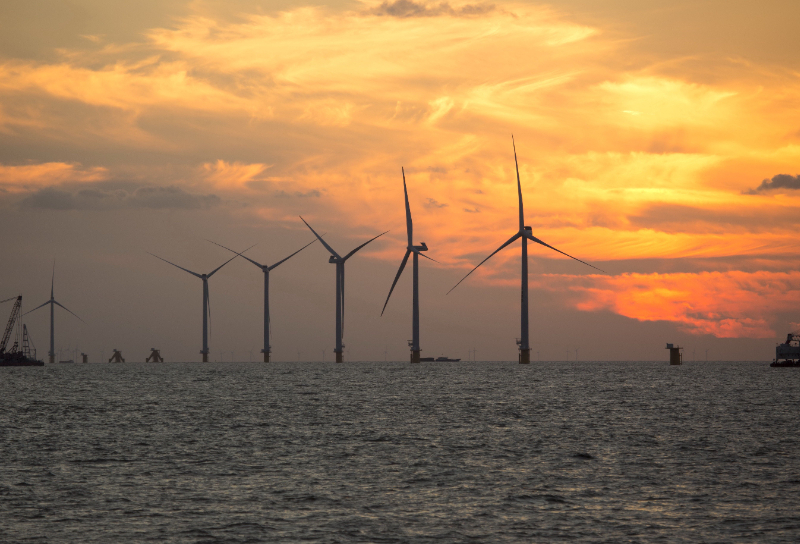
Ørsted: Pairing offshore wind development with marine and coastal species habitat restoration
At a Glance
- Partners: Keelung Wild Bird Society; Maizailiao Cultural Association; Changhua Wild Bird Society; National Taiwan University; National Pingtung University of Science and Technology
- Investment type: Direct investment in conservation programme
- Key business benefit: Addresses the potential collision risks of offshore windfarms, complies with investor biodiversity standards, and supports Ørsted’s social license to operate.
- Key outcomes: Habitat restoration, monitoring, research and education in support of species and habitats adjacent to the windfarm. Data on the impact of the first two years of these interventions coming in early 2027.
The Opportunity
The waters and coast off Changhua County, Taiwan, are home to several species of special conservation status, including the critically endangered Taiwanese Humpback Dolphin, the endemic Taiwan picnic seabream, and the vulnerable Black-faced spoonbill as well as a plethora of other marine mammals, fishes, and birds. Changhua County also has the largest wind energy capacity of any county, municipality or city in Taiwan. In preparing the Greater Changhua Offshore Wind Farm, Ørsted aimed to address the potential impacts of windfarm operations in a highly biodiverse corridor, recognising the importance of coordination across stakeholders and opportunity to meet biodiversity goals in doing so.
The Approach
In developing the Greater Changhua Offshore Wind Farm, Ørsted undertook a Critical Habitat Analysis and Cumulative Impact Assessment for this project, per Equator Principles to manage environmental and social risks required by the project’s investors. Having identified critical habitats and impacts through these assessments, a Biodiversity Action Plan (BAP) was then created to identify actions for the marine mammals, fishes, and birds and their associated habitat to ensure a net gain for species and no net loss of natural habitats.
As outlined in the BAP, Ørsted collaborates with other Taiwanese offshore windfarm developers, researchers, NGOs, regulators and cross sector partners to monitor and evaluate impacts on migratory seabirds and bird species with significant collision risks as well as marine fauna to identify if additional management measures are required. Baseline data were collected in 2025.
Ørsted has also engaged in habitat restoration and enhancement for wading bird species and seabird species identified in the BAP as having critical habitat or significant collision risk. For example, on Mianhua Islet, Ørsted has installed artificial nesting burrows for the Streaked Shearwater with the Keelung Wild Bird Society. At the Zhuoshui River estuary, Ørsted is restoring abandoned fishponds to coastal wetland with the Maizailiao Cultural Association. With the Changhua Wild Bird Society, Ørsted monitors EAAF (East Asian-Australasian Flyway) migratory raptor roosts. Further actions include education, stakeholder engagement and academic research on critical habitat, supported by National Taiwan University and National Pingtung University of Science and Technology.
Value Created
For Ørsted, the actions taken in Greater Changhua provide an offset to identified collision risk from the windfarm while also increasing social license to operate both with the local community as well as globally. Ørsted also sees a learning value in its work in through Greater Changhua as it continues to strive toward its 2030 biodiversity commitment and engage across multiple types of seascapes.
For biodiversity outcomes, Ørsted has a goal for creating gains for species and habitat in the Greater Changhua cluster. Robust restoration and habitat enhancements coupled with monitoring and evaluation will provide quantitative and qualitative data for tracking biodiversity outcomes through time, with first data to verify impact to be reported in early 2027.
Why It Matters / Key Takeaways
This case demonstrates the biodiversity benefit of investor standards supporting corporate biodiversity action and strong implementation for net gain for species and habitat as set by Ørsted. Further, given the density of wind development in the area, the coordination across stakeholder, including other Taiwanese offshore windfarm developers, researchers, NGOs regulators and cross sector partners ensures coordinated monitoring, research, and adaptive management for achieving species and habitat targets not possible with these stakeholders acting in isolation.
Relevant global targets
- Global Biodiversity Framework Targets 2 (restoration), 4 (species recovery), 15 (business assessment of biodiversity impacts), 21 (knowledge and data)
References
- Greater Changhua Southwest Offshore Windfarm in Taiwan Biodiversity Action Plan. June 2025
- Greater Changhua Southwest Offshore Wind Farm in Taiwan Critical Habitat Assessment 16 May 2025
- Her, Kelly (1 January 2017). "Fair Winds". Taiwan Today. Archived from the original on 3 March 2017.
- Ørsted Wins Taiwan Biodiversity Action Award Silver for Second Consecutive Year Demonstrating the Coexistence of Renewable Energy and Nature
- Ørsted Awarded Silver at 2025 Taiwan Biodiversity Action Awards — First Offshore Wind Developer Recognized for Marine Ecosystem Conservation